
The Emerging Role of Urban Agglomerations in Sustainable Smart City Development
Urbanization continues to accelerate globally, reshaping economies, societies, and environments at unprecedented scales. A weak signal gaining momentum is the strategic use of urban agglomerations—clusters of interconnected metropolitan areas—as a framework to improve urban thermal comfort, sustainability, smart city infrastructure, and economic resilience. This approach may redefine how cities grow, govern, and create value, particularly across the Asia-Pacific region where rapid urban expansion coincides with ambitious smart city agendas. Understanding this trend offers new perspectives for governments, investors, and planners seeking to navigate future urban challenges and opportunities.
What's Changing?
Urban agglomerations are not new in name but are evolving as a deliberate strategic architecture for managing urban growth amid resource constraints and climate pressures. In China, for example, conventional urban expansion faces limits due to environmental sustainability and livability concerns. Recent research suggests intensifying the use of urban agglomeration frameworks could help alleviate urban sprawl by concentrating growth in strategically connected metropolitan clusters, enhancing what's called "Potential Urban Areas" (PUAs) to maximize urban thermal comfort and reduce heat island effects (Nature Sustainability).
Simultaneously, across the Asia-Pacific region, governments are heavily investing in smart city initiatives to support this urban concentration. Countries such as India, China, and Southeast Asian nations are projecting rapid industrialization alongside swelling urban populations, fueling demands for integrated intelligent transport, energy demand response systems, and building-integrated photovoltaics (BIPV) within these urban networks (Persistence Market Research; Strategic Revenue Insights).
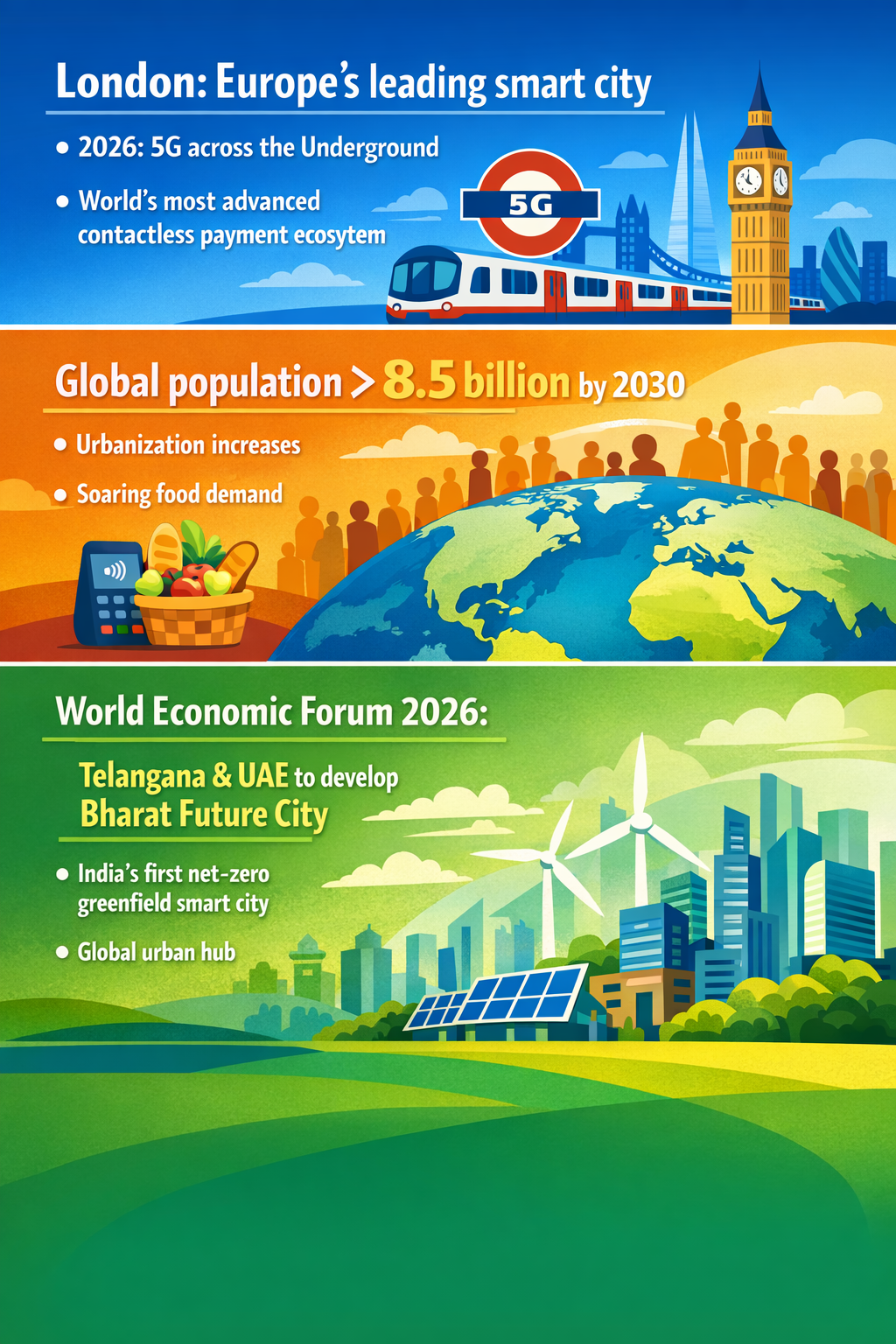
Dubai and Telangana have partnered to develop Bharat Future City, India's first net-zero greenfield smart city, which anticipates leveraging urban agglomeration principles to integrate sustainability, governance, and economic growth at scale (Bankersadda Current Affairs).
The smart city concept is also changing property valuations and urban lifestyles. In Dubai, smart investments underpin new models of property value creation that reflect infrastructure integration, data-driven planning, and environmental sustainability—enabling walkable, tech-enabled communities supported by intelligent infrastructure (Tesla Properties Blog).
Moreover, this urban agglomeration trend dovetails with sustainability innovations such as BIPV glass adoption in the Middle East and Africa, where urban growth converges with climate imperatives. The integration of photovoltaic technologies into building materials becomes more viable at scale within dense urban systems, enabling energy generation without compromising urban form (Reanin Reports).
These developments indicate a shift from isolated, single-city smart projects to interconnected metropolitan systems. This decentralizes innovation across multiple nodes within an agglomeration, enabling improved resource sharing, reduced congestion, and optimized energy use.
Why is this Important?
The urban agglomeration framework could fundamentally redefine urban planning and sustainability strategies. By shifting focus from isolated city-centric interventions to regionally coordinated metropolitan clusters, governments and businesses might leverage economies of scale, enhance infrastructure efficiency, and improve environmental outcomes.
This approach addresses multiple pressing challenges:
- Thermal comfort and climate adaptation: Concentrated urban growth managed within PUAs may reduce excessive heat by enabling targeted green infrastructure and energy-efficient building technologies such as BIPV.
- Sustainable infrastructure investment: Integrated transport and energy demand systems within agglomerations promise greater efficiency and better resource allocation, possibly reducing costs and improving service quality.
- Economic resilience and growth: Multi-nodal urban clusters diversify economic activities and foster innovation ecosystems, potentially mitigating risks linked to over-concentration in single mega-cities.
- Social sustainability: Walkable, connected neighborhoods emerging in agglomerations could enhance quality of life, decrease dependence on vehicles, and reduce emissions.
For investors and developers, new valuation models based on smart infrastructure integration and sustainable urban design could alter real estate markets, as evidenced by changes in Dubai property values tied to smart city investments. This signals potential shifts in asset quality and investment returns in the built environment.
Implications
Organizations and planners should reconsider urban development paradigms through the lens of agglomeration-based strategies. This includes:
- Reevaluating infrastructure planning: Transport, energy, and communication networks may be designed to optimize flows and resilience across multiple interconnected urban centers rather than for standalone cities.
- Prioritizing regional governance frameworks: Effective coordination among municipal, regional, and national governments might be needed to realize the benefits of agglomerations, especially managing shared resources and data systems.
- Adopting integrated technology solutions: Implementation of smart grids, Building-Integrated Photovoltaic (BIPV) systems, and intelligent transport systems (ITS) could be standardized across agglomerations to maximize synergies and sustainability.
- Recognizing evolving real estate dynamics: Investors must assess how sustainability and smart infrastructure influence property values and urban attractiveness, possibly shifting focus from core urban centers to emerging nodes within agglomerations.
- Preparing for demographic and social change: Urban agglomerations could foster diverse, walkable communities that differ markedly from traditional suburban sprawl, necessitating new approaches in housing, urban design, and social services.
Failure to anticipate these shifts could result in suboptimal investments, inefficient urban systems, and missed sustainability targets. Conversely, proactive engagement today might enable a competitive advantage for stakeholders in governance, business, and real estate by shaping emerging smart urban agglomerations.
Questions
- How can policymakers develop governance models that promote cooperation across multiple metropolitan areas within an urban agglomeration?
- In what ways can investments in smart infrastructure be coordinated regionally to improve efficiency and service delivery?
- What role will integrated technologies such as demand response systems and BIPV play in enabling sustainable urban agglomerations at scale?
- How might changing urban real estate valuations driven by smart city integration impact investment strategies in emerging urban clusters?
- What social infrastructure developments are required to support denser, walkable urban agglomeration neighborhoods?
Keywords
urban agglomerations; smart cities; building-integrated photovoltaics; potential urban areas; demand response systems; urban thermal comfort; sustainable infrastructure; mixed-use urban development
Bibliography
- Asia-Pacific represents the fastest-growing region with a projected CAGR of 22% through 2033, driven by rapid urbanization, industrial expansion, and government smart grid initiatives. Persistence Market Research
- Considering that urbanization pressure is likely to continue in the future, China must rely on the urban agglomeration framework to alleviate the pressure to expand metropolitan areas, allowing the potential of PUA to improve urban thermal comfort to be maximized. Nature Sustainability
- Smart city investments in Dubai are fundamentally changing how property values will be created and sustained in the years to come. Tesla Properties Blog
- China's focus on urbanization and the development of smart cities are creating new opportunities for BIPV systems. Strategic Revenue Insights
- Middle East & Africa presents a significant growth opportunity for BIPV glass, driven by increasing urbanization and a focus on sustainable infrastructure. Reanin Reports
- At the World Economic Forum 2026, Telangana and the UAE agreed to explore collaboration for developing Bharat Future City, envisioned as India’s first net-zero greenfield smart city and a global urban hub. Bankersadda Current Affairs