
The Quiet Ascent of Intra-Bloc Micro-Alliances: A Hidden Inflection in Global Institutional Governance
An emergent restructuring within global governance is unfolding through nuanced intra-bloc micro-alliances that exploit fault lines in traditional geopolitical blocs. This weak signal, currently underappreciated, could recalibrate capital flows, regulatory priorities, and industrial strategies by reshaping multilateral institutional coalitions over the next 10–20 years.
While much analysis focuses on headline rivalries between major power blocs, an under-recognized development is the strategic leveraging of intra-bloc divergences by middle and emerging economies to forge issue-specific, cross-regional partnerships. These micro-alliances, exemplified by African states partnering with India and Brazil at the World Trade Organization (WTO) to circumvent Northern subsidies, signal a fracturing—and consequent re-assembly—of governance coalitions in digital trade, agriculture, and export controls. This dynamic challenges assumptions about bloc cohesion in regulatory and governance frameworks and could shift the shape of global regulatory architecture in ways that materially impact capital allocation and industrial positioning.
Signal Identification
This development qualifies as a weak signal because it is subtle, emerging beneath the attention given to major power competition, yet plausibly foundational to future governance structures. It is observable through increasing targeted, issue-specific alliances that cross conventional regional or ideological lines rather than broad geopolitical blocs. Within a 10–20 year horizon, the plausibility of this signal is assessed as medium-to-high given current WTO negotiations and early signals in BRICS-led digital trade talks.
Sectors most exposed include international trade, digital economy governance, agriculture and food security, export control regimes, and regulatory bodies overseeing multilateral institutions.
What Is Changing
The crucial structural development is the strategic exploitation of intra-bloc divergences by states traditionally assumed to align monolithically within regional or ideological blocs. For example, African states have actively partnered with India and Brazil—outside their usual regional blocs—to advocate for carve-outs from Northern subsidies at the WTO. This emerging alliance leverages shared vulnerabilities against highly subsidized developed economies, reshaping agricultural safeguard mechanisms (SSMs) (Frontiers Political Science 22/04/2026).
Complementing this, digital trade negotiations within BRICS emphasize divergent national digital sovereignty and trade priorities, highlighting fractures even among Global South coalitions. This indicates a shift from broad bloc solidarity toward more granular, issue-based coalitions that opportunistically mix partners for regulatory leverage (Frontiers Political Science 22/04/2026).
Global governance institutions simultaneously struggle to keep pace with rapid technological change, exacerbating challenges in maintaining coherent, comprehensive regulatory models. This structural velocity mismatch fuels states’ incentives to experiment with flexible, targeted export control regimes that focus on narrowly defined military and surveillance risks, rather than broad-based, one-size-fits-all frameworks (ETC Journal 19/04/2026).
Meanwhile, geopolitical multipolarity is reinforced by the constructive engagement of China, which advances reform of global governance through multipolar collaboration rhetoric, creating alternative governance trajectories that challenge traditional Western-led institutional architectures (Washington Institute 10/04/2026).
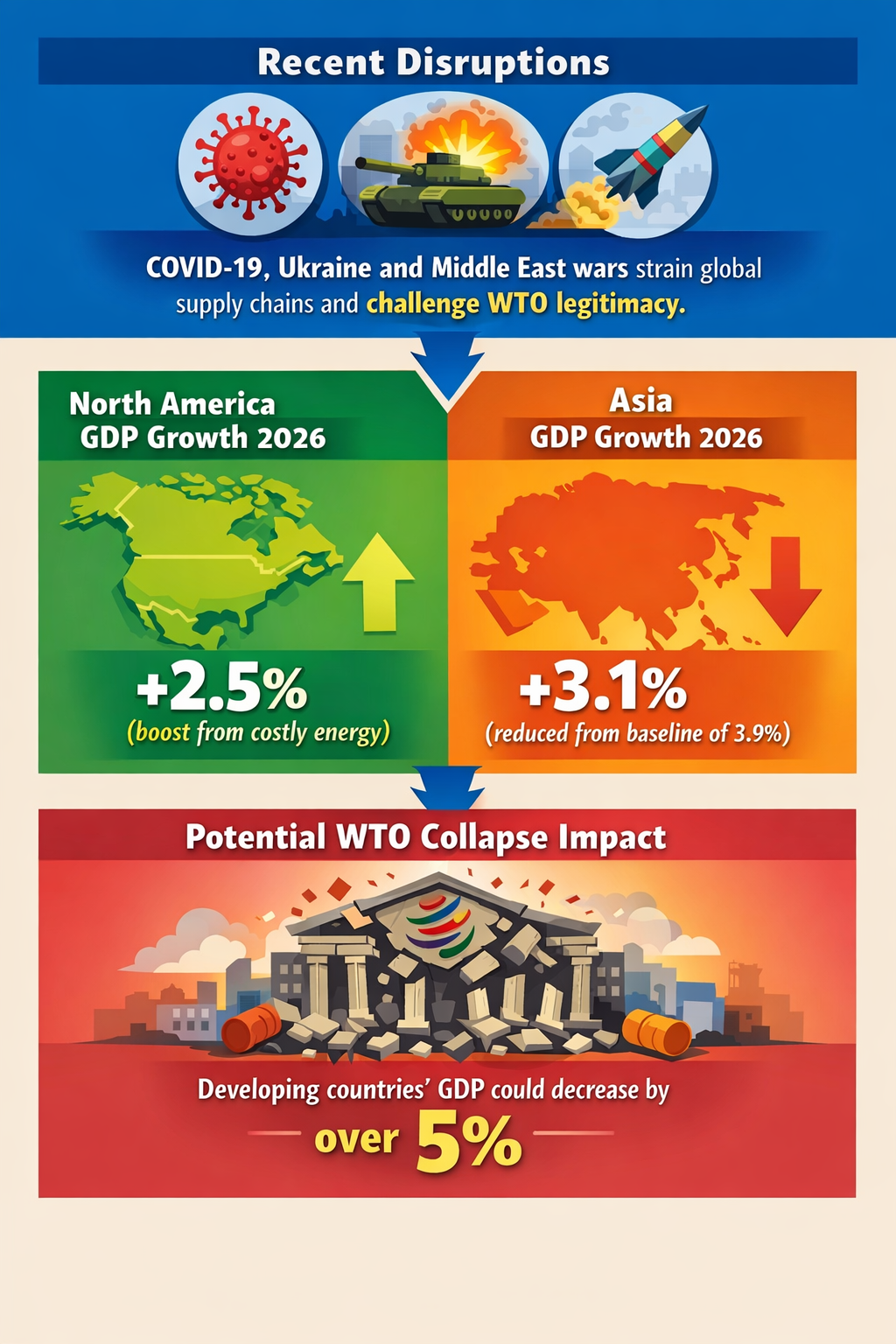
Lastly, external shocks such as uneven economic impacts from geopolitical crises and energy price shocks exacerbate regional divergences, particularly between Asia and North America, intensifying the fragmentation within global economic governance frameworks (The Guardian 25/03/2026). Together, these factors articulate a substantive structural theme of ‘micro-alliance governance’—a reconfiguration wherein governance coalitions become increasingly granular, targeted, and less bloc-dependent, challenging the logic of homogeneous multilateralism.
Disruption Pathway
This weak signal may evolve into structural change as the governance challenges created by technology and geopolitics incentivize states to pivot toward flexible, issue-based cooperation rather than traditional bloc unity. Initial acceleration could occur via intensifying systemic shocks such as technology-driven regulatory gaps in AI, surveillance, and trade, combined with shifting economic growth dynamics post energy shocks.
As cohesion within broad blocks deteriorates under the strain of polycrisis—technological disruption, energy shocks, geopolitical fragmentation—states will likely gravitate toward targeted coalitions that optimize capital deployment, regulatory carve-outs, and industrial support tailored to cross-cutting vulnerabilities. This introduces stresses into existing global governance architectures that were designed for broader, more generalized bloc alignment and undermines the efficacy of comprehensive multilateral frameworks.
Structural adaptations could include institutionalizing micro-alliance negotiation formats within larger multilateral bodies like the WTO or emerging BRICS digital trade forums, enabling flexible, issue-specific regulatory regimes. This may fragment global governance into a matrix of overlapping governance nodes, each with bespoke norms and enforcement mechanisms, especially in sensitive sectors such as agriculture, digital trade, and export controls.
Feedback loops might accelerate this fragmentation as successful micro-alliances validate the approach, prompting other states and sectors to seek tailored collaborations. However, this could also generate unintended consequences such as regulatory incoherence, increased compliance costs, and the proliferation of competing standards that challenge interoperability and increase systemic risk.
Over time, dominant governance models—currently centered on broad-based blocs and comprehensive regimes—could be supplanted by patchwork, networked governance arrangements that combine flexible alliances with multipolar institutional engagement. This would fundamentally reshape regulatory frameworks and necessitate new approaches to strategic intelligence and risk governance in both government and industry.
Why This Matters
For capital allocators, this shift implies new investment risks and opportunities as regulatory certainty becomes fragmented and contingent on coalition dynamics rather than universal standards. Firms with exposure to global supply chains and digital trade may face increased transaction costs and compliance risks due to overlapping and occasionally contradictory regulations emerging from these micro-alliances.
Regulators must anticipate the erosion of traditional bloc-based frameworks and prepare for multilayered, issue-specific coordination mechanisms that require enhanced agility and interagency collaboration. Industrial strategists will need to revisit assumptions about market access, competitive positioning, and innovation ecosystems in light of diverging governance norms across these nascent coalitions.
Governance consequences extend to the legitimacy and effectiveness of multilateral institutions, potentially diminishing their ability to impose global norms and enforce rules uniformly, which could spur further fragmentation or parallel institution-building, especially among influential emerging powers.
Implications
This signal may drive a structural pivot in global governance from monolithic bloc governance toward networked, flexible micro-alliance frameworks. Governance may evolve into a composite of issue-specific, cross-regional partnerships that filter capital allocation, regulatory preferences, and industrial policies through granular alliance lenses.
It is unlikely to be a transient fad given the technological and geopolitical pressures eroding cohesive bloc identity and the institutional inertia against rapid comprehensive reform. Rather, this development might realign the global geopolitical economy in a more complex, fragmented, and pluralistic direction.
This trend is not synonymous with the complete collapse of multilateralism, nor is it merely an extension of current regionalism—rather it represents an orthogonal restructuring of coalition logic within existing multilateral forums, enabled by technology and political agency.
Competing interpretations might argue this as a short-term tactical maneuver by weaker states or as noise amplified by discrete sectors. However, the convergence of digital trade, agricultural SSM debates, export control reform, and geopolitical multipolarity suggests substantive structural momentum.
Early Indicators to Monitor
- Increasing frequency and formalization of cross-bloc, issue-specific trade and regulatory alliances at the WTO and BRICS forums.
- Legislation or regulatory proposals incorporating selective carve-outs or differentiated treatment tied to micro-alliance membership rather than regional blocs.
- Surges in venture investments and procurement favoring technologies compliant with multiple, overlapping regulatory regimes emerging from flexible coalitions.
- Institutional reforms within multilateral organizations explicitly enabling flexible coalitions or separate negotiating tracks.
- Policy statements or diplomatic communiqués emphasizing multipolar, issue-based cooperation rather than monolithic bloc solidarity.
Disconfirming Signals
- Reassertion of unified bloc negotiation postures, especially if major powers reduce intra-bloc fissures through trade or security settlements.
- Emergence of comprehensive, interoperable global regulatory frameworks that fully integrate advancing technologies and geopolitical complications within traditional multilateral bodies.
- Failure of targeted alliance negotiations due to diverging interests within proposed micro-coalitions, leading back to bloc-centric diplomacy.
- Significant shift toward protectionist, unilateral trade and regulatory policies that bypass multilateral alliance structures altogether.
Strategic Questions
- How prepared is your institution to navigate and influence issue-specific micro-alliances that may override existing bloc-based trade and regulatory norms?
- What adaptive governance and risk management frameworks are needed to address the operational and compliance complexities arising from fragmented, overlapping regulatory coalitions?
Keywords
Intra-Bloc Alliances; Micro-Alliances; Global Governance; Multilateralism; Trade Regulation; Digital Trade; Export Controls; Political Risk; Geopolitical Fragmentation; Capital Allocation
Bibliography
- African states exploit intra-bloc divergences through targeted alliances: Partnering with India and Brazil on agricultural SSMs at the WTO, leveraging shared vulnerabilities to Northern subsidies to push for carve-outs in BRICS-led digital trade rules. Frontiers Political Science. Published 22/04/2026.
- Global governance will struggle to keep pace with technological change. InAirspace. Published 15/02/2026.
- For Canadian exporters, weakened global governance means increased trade uncertainty and systemic risk, raising the cost of doing business. Export Development Canada. Published 01/03/2026.
- Conversely, a more narrowly targeted export-control regime-focused on clearly defined military and surveillance risks - could coexist with robust global governance and interoperable regulatory frameworks. ETC Journal. Published 19/04/2026.
- China will continue to play a constructive role in reforming global governance, and work with all countries toward a multipolar world. Washington Institute. Published 10/04/2026.
- The hit to growth will be equally lopsided: while costly energy would boost GDP growth in North America in 2026 to 2.5%, according to the WTO, from a baseline of 2.3%, it would slow GDP growth in Asia to 3.1% from 3.9%. The Guardian. Published 25/03/2026.