
The Imminent Disruption of GLP-1 Monopoly by Non-GLP-1 Obesity Drugs: A Silent Structural Inflection in Diet Pharmaceuticals
Emerging innovations beyond GLP-1 receptor agonists promise to fracture the obesity drug market’s current dynamics, potentially reshaping capital flows, regulatory approaches, and competitive hierarchies over the next decade. This insight identifies the rapidly intensifying non-GLP-1 receptor (non-GLP-1 R) obesity drug segment as a subtle but profound emerging inflection largely overlooked amid GLP-1 enthusiasm. As this category matures, it could catalyse a paradigm shift away from peptide-dominant therapies toward diverse molecular modalities and strategic fragmentation.
Despite GLP-1 receptor agonists’ current market dominance and projected revenue growth surpassing $150 billion by 2030, a nascent but accelerating suite of alternative mechanism treatments is poised to scale dramatically. This signals a potential multi-polar competitive landscape, with foundational implications for industry capital strategies, pricing regimes, regulatory frameworks, and patent lifecycles. Recognising this under-the-radar shift is crucial for decision-makers tasked with balancing near-term wins against long-term structural uncertainties.
Signal Identification
This development qualifies as an emerging inflection indicator rather than transient noise or a simple weak signal. The inflection arises from sustained early-stage innovation in non-GLP-1 R obesity therapies—such as calcitonin receptor agonists—and their forecasted 50-fold sales surge within the next 5–10 years (PharmAlive 18/02/2026). The time horizon (5–10 years) is sufficiently near-term to influence capital allocation while far enough out to allow systemic regulatory and market adaptations. The plausibility band is high, given clinical advancements, regulatory approvals, and patient demand for diversified mechanisms. Key exposed sectors include pharmaceuticals, biotechnology, health insurance, supply chain logistics, and regulatory bodies overseeing drug approval and pricing frameworks.
What Is Changing
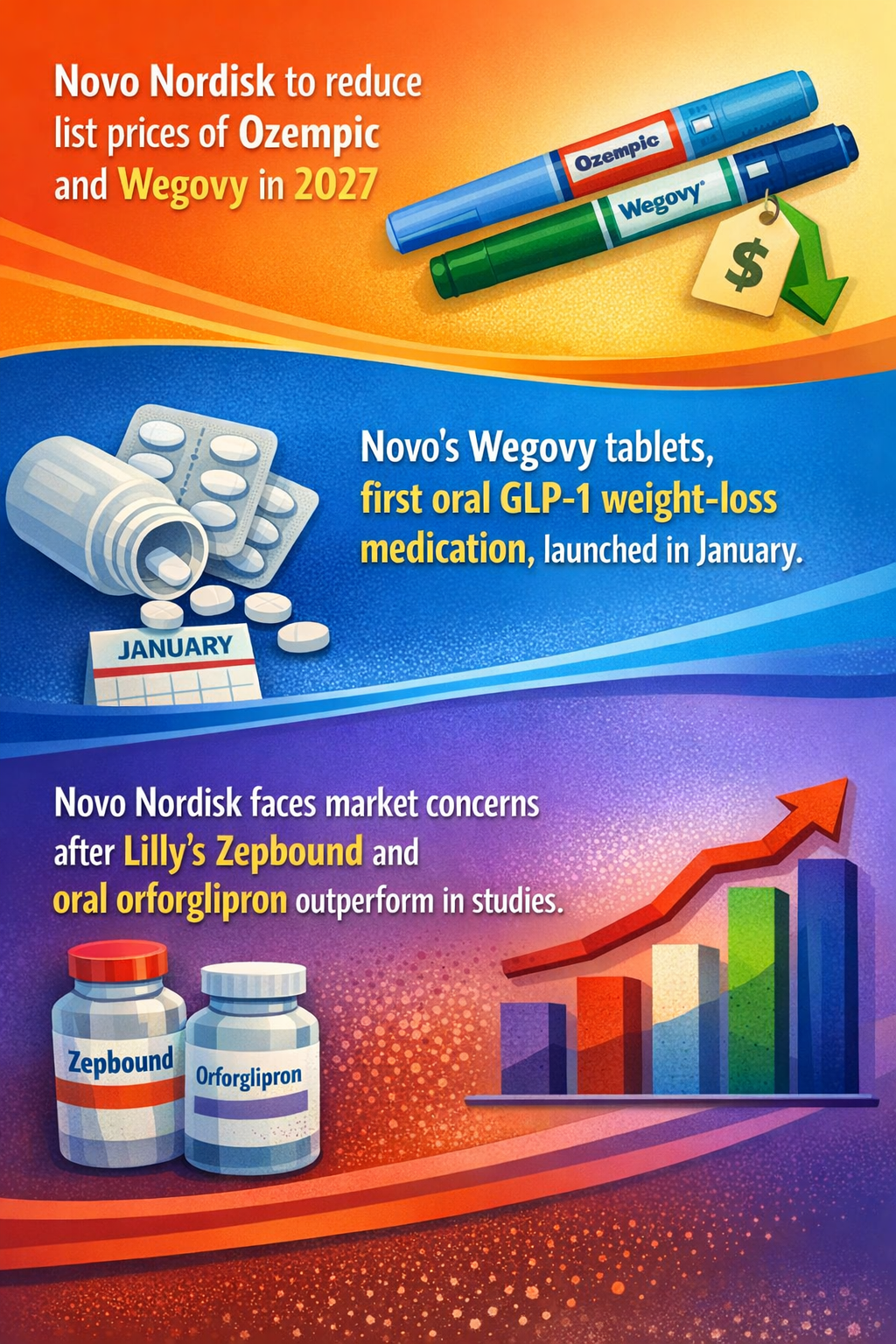
The intense focus and commercial investment in glucagon-like peptide-1 receptor (GLP-1 R) agonists—exemplified by Novo Nordisk’s blockbuster drugs Ozempic and Wegovy—have dominated obesity pharmacotherapy innovation and market narratives. Novo Nordisk’s recent strategy to reduce GLP-1 drug prices post-2026 (Yahoo Finance 12/04/2026), coupled with the arrival of oral GLP-1 options like Wegovy tablets (46Brooklyn 18/01/2026), reveal attempts to consolidate and expand this class’s market dominance. However, these moves occur alongside mounting competitive pressures and erosion of premium pricing power (SWOTPal 22/04/2026), intensified by generic semaglutide (a leading GLP-1 drug compound) flood from Indian manufacturers aggressively targeting market share (Chemistry World 03/03/2026).
Concurrently, despite the current minor commercial footprint of non-GLP-1 R drugs (projected at only $310 million in 2026), their landscape is rapidly evolving. Novel obesity therapeutic targets, such as peptides acting on the calcitonin receptor (CR), have garnered increased R&D attention and clinical progress (Pharmaceutical Technology 10/02/2026). GlobalData forecasts a staggering 50-fold sales increase for non-GLP-1 R drugs by 2031 (PharmAlive 18/02/2026). This suggests a steep growth trajectory that traditional GLP-1 centric analyses systematically underweight in strategic assessments.
What is genuinely under-recognised is the systemic challenge these alternative treatments pose to the entrenched GLP-1 model. Current GLP-1 drugs enjoy significant clinical mindshare and infrastructure support, but the erosion of pricing premiums combined with patient cohorts that do not tolerate GLP-1 side effects or are needle-averse (CNBC 07/04/2026) opens the door for differentiated, non-peptide-based obesity drugs targeting alternative mechanisms—potentially oral small molecules or novel biologics. This represents a strategic inflection where diversification becomes a survival imperative.
Disruption Pathway
The transition from GLP-1 monopoly to a multi-modal obesity drug market may escalate under several accelerating conditions. First, continued GLP-1 pricing pressure from generics and increased payor resistance (Yahoo Finance 12/04/2026) reduces margins, incentivizing pharmaceutical companies to invest in alternative therapies. Second, rising clinical data validating non-GLP-1 therapeutic efficacy and safety profiles (Pharmaceutical Technology 10/02/2026) expands the addressable patient population beyond those served adequately by GLP-1s.
These forces create stresses on the GLP-1-centred ecosystem: patent cliffs invite generic competition; price compression reduces R&D reinvestment; and patient heterogeneity demands broader therapeutic options. In response, industrial structures may fragment, with new entrants in non-GLP-1 niches attracting venture funding and incumbents diversifying pipelines. Regulatory bodies, challenged to evaluate a broader range of mechanisms and delivery forms, may adopt more flexible approval pathways and real-world evidence requirements.
Feedback loops could emerge as increased competition drives further price declines, accelerating demand elasticity and fostering rapid uptake of alternative therapies. Conversely, prescriber and payer adoption inertia may slow transitions, preserving GLP-1 dominance in the short term but heightening longer-term disruption risk. Such dynamics could shift the oligopolistic market into a more heterogeneous field, reshaping strategic positioning, supply chains, and pricing models.
Ultimately, the dominant industry models—now reinforced by a focus on GLP-1 peptides and their delivery formats—could pivot toward platform-agnostic obesity treatments spanning peptides, small molecules, and other novel biologics. Meanwhile, regulatory frameworks might evolve to accommodate these modalities through revised clinical trial paradigms and post-market surveillance tailored for a diversified pharmacological landscape.
Why This Matters
For capital allocators, recognizing the growing viability of non-GLP-1 obesity drugs could reorient investment away from GLP-1 monoculture toward diversified innovation portfolios. Early shifts may render incumbent pipeline-centric valuations volatile and heighten M&A activity focused on emergent mechanisms.
Regulators face growing complexity requiring adaptive assessment frameworks and perhaps earlier market access pathways for alternative obesity therapies, balanced against real-world data obligations ensuring safety and efficacy across heterogeneous patient populations.
For industry leaders, anticipating this inflection is critical for maintaining competitive positioning, as failure to invest beyond GLP-1 technologies risks obsolescence in a diversifying market. Supply chains anchored to peptide biologics may need reconfiguration to integrate small molecule manufacturing and distribution.
Similarly, health systems and payors must prepare for broader therapeutic options with disparate cost structures and adherence profiles, impacting reimbursement models and clinical guidelines.
Implications
This development could likely catalyse a structurally more fragmented obesity drug market within 5–10 years, moving beyond the current GLP-1 oligopoly. It might force price normalization, reduce barriers for entry, and stimulate therapeutic pluralism.
It is unlikely to render GLP-1 drugs obsolete promptly; rather, coexistence and therapeutic stratification may dominate the medium term. Investors must avoid interpreting the non-GLP-1 rise as hype, recognizing it as a clinically and commercially grounded inflection.
Conflicting interpretations exist: some may view the non-GLP-1 uptick as marginal or too nascent; others might underestimate regulatory inertia or market loyalty. Nonetheless, available data suggest the competitive landscape will diversify materially, shaping future industry structure.
Early Indicators to Monitor
- Volume and pace of clinical trial approvals and positive data releases for non-GLP-1 R obesity drugs.
- Regulatory guidance evolution specific to novel obesity drug mechanisms and formulations.
- Venture capital and corporate R&D reallocation towards non-GLP-1 drug platforms.
- Emergence of reimbursement policies or formulary shifts favoring diversified mechanism drugs.
- Patent filings and licensing deals involving non-GLP-1 R targets or delivery technologies.
Disconfirming Signals
- Failure or delays in pivotal clinical trials demonstrating non-GLP-1 R drugs’ efficacy or safety.
- Regulatory setbacks or introduction of prohibitive approval requirements specific to alternative mechanism drugs.
- Strong, sustained GLP-1 drug pricing power protected by exclusive contracts or patent extensions.
- Lack of investment or corporate pivot away from non-GLP-1 mechanisms reducing innovation velocity.
- Patient and prescriber preference strongly consolidating around GLP-1 therapy despite alternatives.
Strategic Questions
- How should pharmaceutical R&D portfolios balance investment between GLP-1 extensions and emerging non-GLP-1 targets over the next decade?
- What regulatory adaptations are necessary to fairly evaluate and incorporate diversified obesity drug modalities without compromising safety or efficacy?
Keywords
GLP-1 receptor agonists; non-GLP-1 receptor obesity drugs; obesity pharmaceuticals; regulatory frameworks; pharmaceutical pricing pressures; market inflection; clinical trial innovation; diet drug innovation
Bibliography
- The bonanza of generic semaglutide medicines in India will likely be accompanied by intensive marketing efforts as the various manufacturers compete for their share. Chemistry World. Published 03/03/2026.
- Pharmaceutical giant Novo Nordisk is planning to drastically reduce the list prices of its popular GLP-1 treatments, including Ozempic and Wegovy, in 2027. Yahoo Finance. Published 12/04/2026.
- Currently, there is limited interest in the non-GLP-1 R obesity field, as sales for obesity drugs targeting alternative mechanisms are only forecast to generate a mere $310m in 2026. Pharmaceutical Technology. Published 10/02/2026.
- GlobalData forecasts the sales of the non-GLP-1 R landscape, including calcitonin receptor (CR) products, to surge 50-fold over the next five years. PharmAlive. Published 18/02/2026.
- The Wegovy pill is attracting patients with a fear of needles, which is estimated to affect up to 25% of U.S. adults. CNBC. Published 07/04/2026.
- As more options reach market, pricing power erodes, differentiation becomes harder, and the semaglutide premium that built Novo Nordisk's margins will compress. SWOTPal. Published 22/04/2026.
- In January, the much-anticipated first oral version of the hot GLP-1 weight-loss medications made its debut - Novo's Wegovy tablets - a timeframe that is undoubtedly strategic. 46Brooklyn. Published 18/01/2026.