
AI-Driven Autonomous Governance as a Weak Signal in Tokenised & Decentralised Finance
Artificial intelligence (AI)-empowered self-healing decentralized finance (DeFi) protocols represent an under-recognized inflection that may fundamentally reshape governance, risk management, and regulatory frameworks across tokenised and decentralized finance over the next decade.
Beyond current emphases on security, interoperability, and stablecoin regulation, the gradual introduction of AI agents capable of real-time contract auditing and autonomous governance interventions may constitute a paradigm shift. These capabilities could alter capital allocation dynamics, trigger redefined legal accountability, and compress operational frictions in a manner that classical regulatory instruments are ill-equipped to handle. This paper probes the systemic significance of embedding AI agents in DeFi governance and their plausible evolution as a structural disruptor in financial and industrial ecosystems.
Signal Identification
This development qualifies as an emerging inflection indicator due to its nascent but accelerating capacity to autonomously engineer corrections within DeFi protocols—a complexity layer transcending traditional peer governance or manual auditing. The signal is grounded in credible projections forecasting self-healing DeFi ecosystems powered by AI agents by 2030 (KuCoin 15/04/2026). Its plausibility band is medium to high on a 10–20 year horizon considering current trajectories in both AI development and DeFi integration. Sectors exposed include financial services, regulatory compliance, blockchain infrastructure providers, artificial intelligence industries, and legal services focused on financial accountability.
What Is Changing
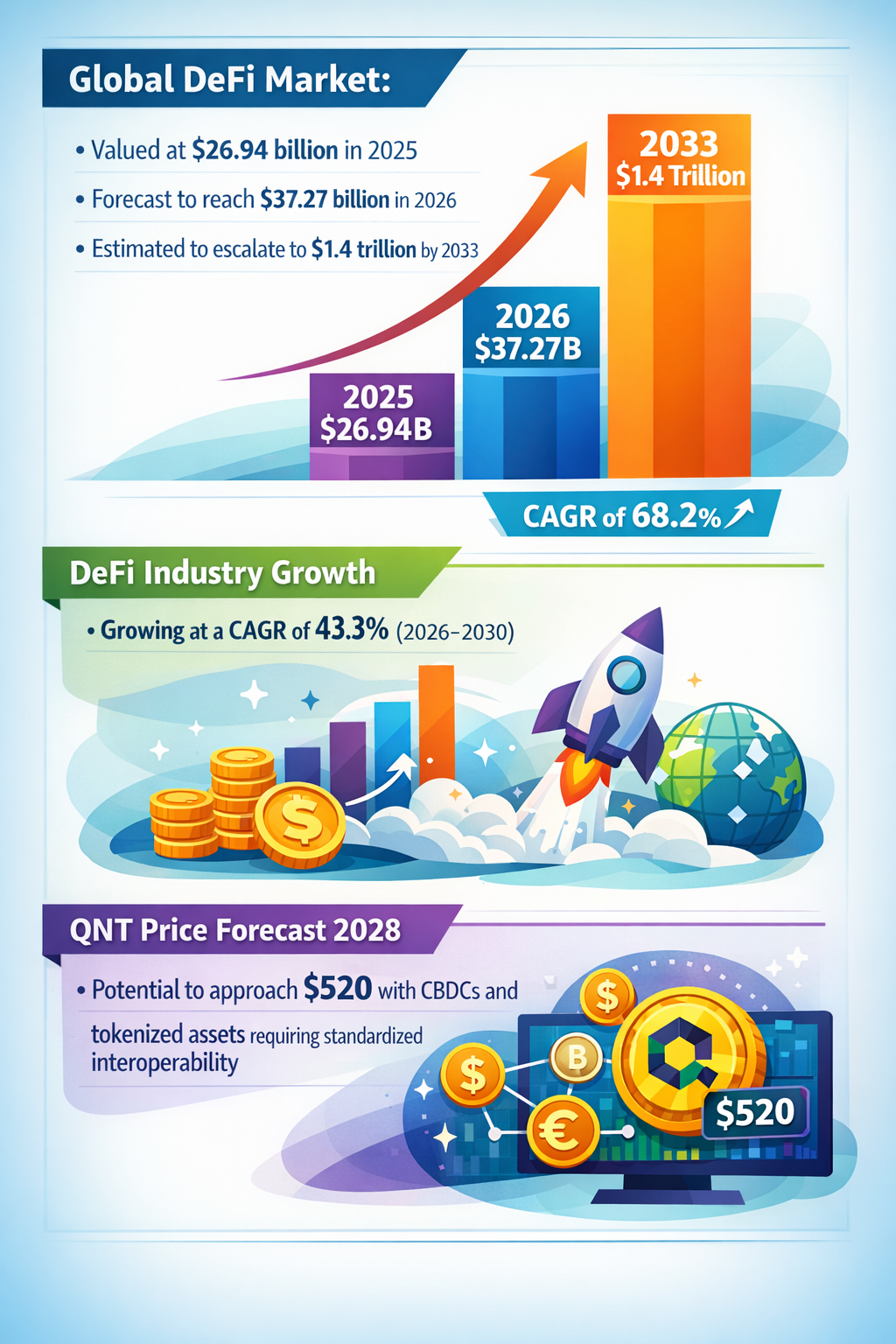
DeFi is positioned for rapid quantitative expansion, projected to grow from a $26.94 billion market in 2025 to a $1.4 trillion valuation by 2033, reflecting compounded interest in decentralized, tokenised financial instruments (ReckonSys 20/03/2026). While security remains a critical conversation, the integration of AI for continuous real-time auditing introduces qualitatively new operational resilience.
Tokenised assets and real-world asset (RWA) integration with DeFi protocols are also advancing, introducing interdependencies that heighten systemic complexity (Yellow 01/04/2026). These interdependencies intensify the need for instant, adaptive governance mechanisms to mitigate risks emergent in on-chain settlements and cross-domain financial operations.
Simultaneously, stablecoin regulatory efforts—particularly under frameworks such as the GENIUS Act in the USA—illustrate increasing government interest in imposing traditional reserve and disclosure rules on tokenised money (CoinPro 10/02/2026). These measures, while stabilizing, may stifle flexibility unless counterbalanced by automated governance tools capable of fluid adaptation to regulatory demands and market shocks.
Recurring themes converge on the need for decentralized protocols to dynamically integrate cross-chain data (AI Oracle Networks, cross-chain bridges, predictive analytics) enabling proactive rather than reactive management of contract risk and execution (OpenPR 12/04/2026). AI agents are projected to assume functions akin to continuous, distributed compliance auditors, moving governance closer to autonomous regimes.
Disruption Pathway
The pathway to structural disruption begins with the incremental deployment of AI auditing agents within critical DeFi protocols, initially augmenting human oversight by flagging vulnerabilities and suggesting patches. As these agents improve, catalysts such as high-profile smart contract failures, liquidity crises, or regulatory mandatories for audit transparency could accelerate adoption. Integration with advanced cross-chain analytics augments these agents’ predictive capacity, allowing near-instantaneous adjustments across decentralized governance subnets.
Traditional financial actors and regulators experience mounting stresses as emergent AI governance agents erode conventional control levers; manual interventions lag behind autonomous adjustments, challenging existing compliance paradigms. Established legal frameworks for liability and accountability become strained in attributing errors when AI acts independently within protocol ecosystems.
Structural adaptations may follow: regulatory bodies may evolve towards certifying or licensing trusted AI governance frameworks, creating new institutions that oversee AI agent standards rather than individual transactions. Financial intermediaries may shift focus from transactional execution towards AI governance integration and risk control, restructuring competitive hierarchies. The resulting feedback loop—where improved AI governance boosts user confidence and liquidity—could exponentially increase DeFi adoption, further incentivizing refinement of autonomic systems.
However, unintended consequences may include overreliance on AI accuracy, with potential cascading failures in black-box AI models or adversarial exploitation of AI governance logic, necessitating layered resilience designs and hybrid human-AI oversight. The dominant models of industrial organization and regulation could shift towards hybrid technocratic governance emphasizing algorithmic rule enforcement knit with legal frameworks overseeing AI integrity.
Why This Matters
For capital allocators, AI-driven autonomous governance suggests a pivot towards investing in protocol infrastructures incorporating adaptive AI risk management capabilities, as these may outperform traditional smart contract frameworks by reducing systemic risk. Capital may also flow towards enterprises enabling AI-DeFi integrations, including AI oracle networks and cross-chain bridges.
Regulators face profound challenges: static rulebooks are ill-suited to autonomously evolving AI protocols capable of instant adjustments. This may prompt the design of dynamic, algorithm-aware regulatory frameworks that certify or audit AI governance architectures rather than individual transactions, advancing compliance from transaction-level ex post audits to continuous protocol-level oversight.
Industrial strategy will need to recalibrate as incumbent intermediaries (e.g., banks, clearing houses) confront protocol-native AI governance that may dispense with their services, urging repositioning as service providers to AI-enhanced decentralized ecosystems or embracing AI themselves.
Supply chains for blockchain infrastructure will shift emphasis from raw protocol deployment towards AI and machine learning integration expertise, fostering new ecosystem players. Legal liabilities related to failures or exploits in AI governance become complex, potentially necessitating new insurance products and liability regimes.
Implications
This signal could plausibly catalyse structural change rather than transient evolution in decentralized finance, shifting governance models from human-centric committees towards autonomous AI oversight within a decade. DeFi protocols incorporating AI self-healing mechanisms may scale faster due to reduced operational risk and liquidity lock-ins.
However, the development should not be conflated with unregulated crypto hype or poorly secured smart contracts; autonomous AI governance demands sophisticated intelligence architectures and strong baseline security protocols to function effectively. Competing interpretations may regard AI governance as a niche enhancement rather than systemic disruption—though rising complexity and interdependencies within DeFi argue for the latter.
Early Indicators to Monitor
- Deployment of live AI-based auditing and patching systems in major DeFi protocols
- Venture funding clustering around AI governance frameworks within blockchain sectors
- Formation of industry standards or certifications for AI-augmented smart contracts
- Regulatory consultations or legal precedents addressing AI agent liability in DeFi
- Growth and adoption rates of AI oracle networks and predictive analytics SDKs for DeFi
Disconfirming Signals
- Persistent regulatory crackdowns that prohibit or restrict AI-driven autonomous governance interventions
- Widespread failure of early AI governance agents leading to loss of trust in AI-managed DeFi
- Technological stagnation in AI-smart contract interoperability and real-time auditing tools
- Supreme court or legislative decisions cementing exclusive human legal accountability incompatible with autonomous AI actions
- Emergence of viable centralized alternatives that re-establish human control as preferable
Strategic Questions
- How can regulatory frameworks evolve to certify and monitor autonomous AI governance agents within decentralized protocols?
- What investments in AI-augmented DeFi infrastructure will most enhance portfolio resilience against smart contract risk?
Keywords
Decentralized Finance; Artificial Intelligence; Smart Contracts; Governance; Tokenisation; Stablecoins; Interoperability; Regulation; Autonomous Systems; Capital Allocation
Bibliography
- The global DeFi market was valued at $26.94 billion in 2025 and is forecast to reach $37.27 billion in 2026 - before accelerating to an estimated $1.4 trillion by 2033 at a CAGR of 68.2%. ReckonSys. Published 20/03/2026.
- By 2030, DeFi protocols will be self-healing, with AI agents constantly auditing their own smart contracts and suggesting real-time patches to governance subnets like Bittensor. KuCoin. Published 15/04/2026.
- The question for 2026 is no longer whether RWAs will integrate with DeFi lending but how deeply the operational dependencies between traditional finance clearing infrastructure and on-chain settlement will run. Yellow. Published 01/04/2026.
- The GENIUS Act in the USA creates a nationwide framework for stablecoins and could further accelerate their everyday use. CoinPro. Published 10/02/2026.
- The AI Oracle Network SDK and cross-chain bridges planned for Q2 2026 could open doors for developers building everything from predictive analytics in DeFi to optimized supply-chain solutions. OpenPR. Published 12/04/2026.