
Peptide Compounding: A Wildcard Innovation Poised to Disrupt Health Futures
Emerging regulatory shifts enabling legal peptide compounding may catalyse far-reaching transformations in healthcare delivery, capital allocation, and industry structure. This evolving frontier represents a wildcard that challenges conventional pharmaceutical production and care models with decentralised, precision-integrated therapies.
The near-term legalisation of multiple peptide compounds in the U.S., combined with telehealth's meteoric rise and AI-driven healthcare platforms, signals a nascent ecosystem primed for systemic disruption. Despite considerable focus on telehealth, personalized medicine, and AI diagnostics, the potential for compounded peptides, fabricated through decentralised channels, to redefine treatment paradigms remains widely underappreciated. This paper explores how this development could scale beyond niche pharmaceutical innovation and permeate regulatory, industrial, and capital domains over the coming two decades.
Signal Identification
This development qualifies as a wildcard—a relatively low likelihood but high impact, potentially transformative innovation with limited current recognition. The immediate trigger is regulatory evolution, notably the expected FDA endorsement for production of as many as seven legal peptides (Forbes 22/07/2026). As the regulatory pathway clears, compounding pharmacies and telehealth companies stand ready to commercialise novel peptide therapeutics via scalable, decentralised channels.
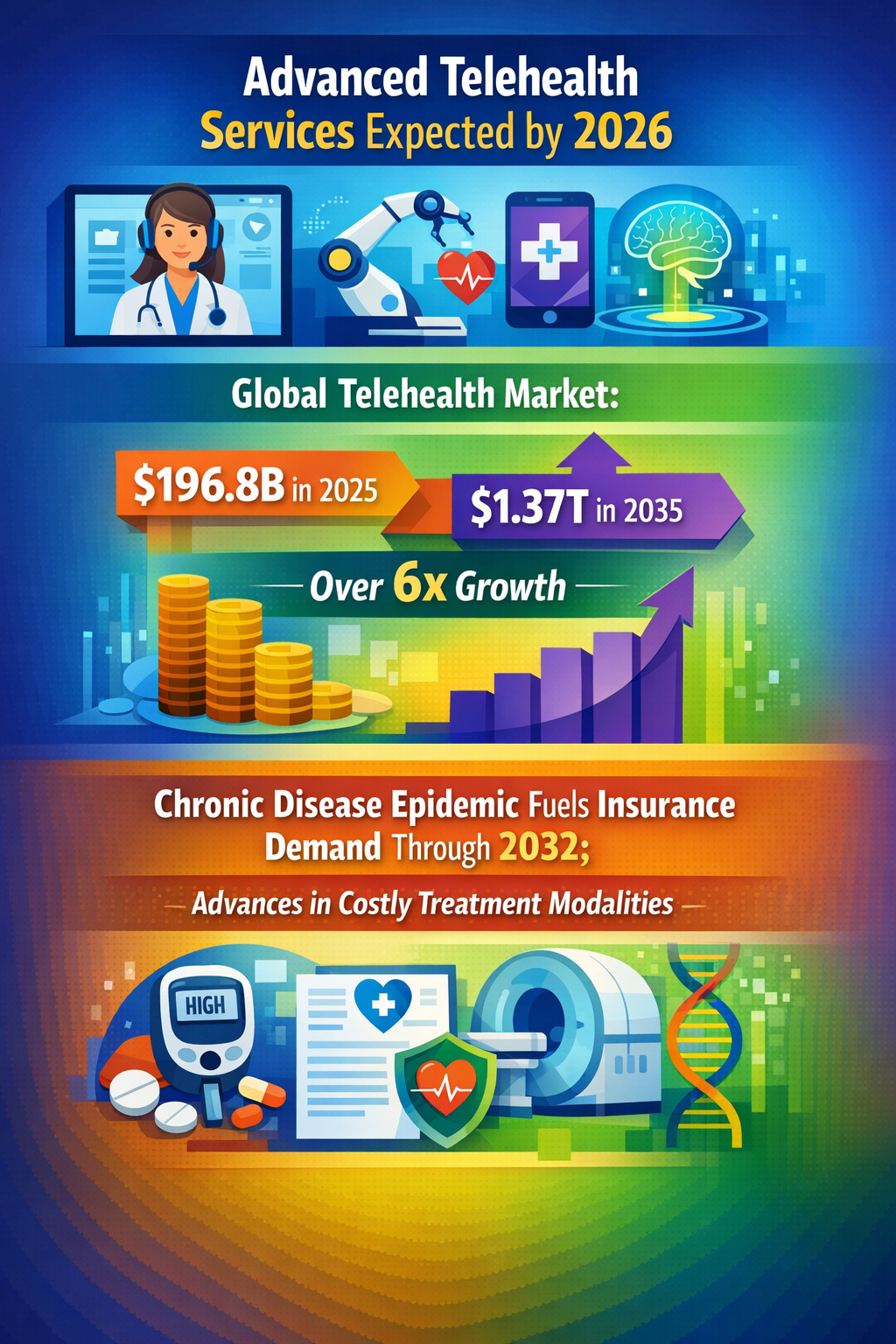
The plausible horizon ranges from 5 to 20 years, given regulatory, clinical validation, and industrial ecosystem build-out timescales. The plausibility is medium-high given existing infrastructural momentum in telehealth adoption (34.15% CAGR by 2031), electronic health record (EHR) integration, and personalized medicine trends (Mordor Intelligence 15/11/2023). Exposed sectors include pharmaceutical manufacturing, telehealth services, healthcare data analytics, chronic disease management, and regulatory frameworks governing drug compounding and personalised therapies.
What Is Changing
The confluence of regulatory liberalisation of peptides, telehealth's exponential growth, and AI-infused platforms signals a substantive shift in healthcare delivery and industrial configuration. First, telehealth's expansion exemplifies decentralisation, moving care out of hospitals into patient homes, particularly for chronic disease and post-acute management, where the U.S. market anticipates commanding 64.1% share by 2026 (Persistence Market Research 12/01/2024). This relocation aligns closely with decentralised peptide compounding, which leverages local pharmacies and tele-prescribers to deliver highly tailored therapies.
Second, advances in integration of personalized medicine protocols and EHRs enable more precise patient data utilization for treatment customisation (Mordor Intelligence 15/11/2023). This foundation is crucial to safely deploying complex peptide sequences tailored to individual biomarker profiles and disease stages, moving beyond traditional one-size-fits-all pharmaceuticals.
Third, the maturation of AI-integrated diagnostics and imaging, such as cost-optimized elastography platforms in Asia Pacific, underscores the potential for algorithmically guided therapeutic selection and delivery optimisation (Persistence Market Research 07/02/2024). When coupled with peptide compounding, this introduces a systemic shift toward embedded, adaptive treatment regimens monitored through decentralised instrumentation.
Finally, the market dynamics driven by an ageing global population with rising chronic disease burden, necessitating comprehensive coverage models, further cement demand for flexible, patient-centric therapies (PS Market Research 18/03/2024). This demographic imperative heightens receptivity to innovative modalities like compounded peptides that can be more responsively adapted to changing health states.
Disruption Pathway
Initially, regulatory approvals such as the anticipated FDA endorsement will catalyse legal innovation in peptide compounding, lowering barriers for smaller compounding pharmacies and telehealth firms to provide tailored therapeutics (Forbes 22/07/2026). This may accelerate investment in AI-driven personalised treatment protocols and digital health records interoperability to support safe, efficacious peptide deployment at scale.
These conditions will exert stresses on traditional pharmaceutical manufacturers, whose centralised, high-capital production models may struggle to compete with proliferating micro-factories and local pharmacies providing customised peptide therapies on demand. Reimbursement models, currently oriented toward standardised pharmaceuticals, may likewise be pressured to adapt to decentralised, rapidly adjustable products delivered in home-care or telehealth contexts (Towards Healthcare 05/12/2023).
This dynamic could provoke structural adaptations including new regulatory frameworks governing compounded peptide quality assurance, digital traceability standards within EHRs, and licensing regimes for local production. Feedback loops may emerge as peptide therapeutics coupled with telehealth monitoring drive improved patient outcomes, creating a virtuous cycle reinforcing demand for adaptable, near-patient pharmaceutical synthesis. Conversely, risks of quality control failures might trigger rapid regulatory tightening, posing countervailing pressures.
Ultimately, these forces may shift dominant industrial models from global pharmaceutical oligopolies toward an ecosystem of digitally coordinated, distributed production and delivery nodes integrating AI diagnostics, patient data, and telehealth consultation. Governance may evolve to incorporate tighter surveillance of compounding safety and efficacy, with implications for liability and regulatory jurisdiction.
Why This Matters
The evolution of legal peptide compounding integrated into telehealth platforms potentially redefines capital allocation patterns by lowering entry barriers and fragmenting pharmaceutical production. Investors may need to recalibrate from large-scale pharma plants toward digitally enabled local production and AI data services. Regulators face complex oversight challenges balancing innovation facilitation against patient safety in decentralised manufacturing contexts.
From a competitive standpoint, incumbent pharmaceutical firms risk disruption from agile compounding players and telehealth aggregators able to deliver hyper-personalised therapeutics. Supply chains could shift towards more localised sourcing of peptide precursors and manufacturing inputs, impacting global API (active pharmaceutical ingredient) distribution. Liability frameworks may need revamping to allocate risk between digital prescribers, local compounders, and telehealth platforms.
For policy-makers and health system planners, this development complicates standardisation and quality assurance but offers potential for scalable solutions to chronic disease management and ageing demographic pressures. Forward-looking governance must anticipate these structural shifts to maintain patient safety while fostering innovation.
Implications
This wildcard could likely scale into a structural change, transforming how therapies are manufactured, regulated, and delivered within the next two decades. Capital flows may shift toward AI analytics, local compounder networks, and telehealth infrastructure expansion. Regulatory frameworks might evolve toward harmonised but flexible standards for decentralised pharmaceutical production, embedding digital traceability within personalized medicine protocols.
However, this evolution is not guaranteed. It should not be conflated with incremental telehealth expansion or nascent AI healthcare tool adoption, which are advancing along more predictable trajectories. Instead, peptide compounding represents a discrete potential paradigm shift combining decentralised manufacturing, emerging regulatory permission, and personalised therapeutic capability.
Alternative interpretations could minimise its transformative impact, framing peptides as a niche innovation lacking broad clinical acceptance or regulatory stability. Yet growing convergent investments and ageing population pressures make this unlikely to remain marginal over the medium term.
Early Indicators to Monitor
- FDA approvals and regulatory drafts concerning peptide compounding and decentralised pharmaceutical manufacturing
- Venture capital flows targeting telehealth-enabled compounding pharmacies and peptide synthesis platforms
- Patent filings for AI-integrated personalized peptide therapy algorithms
- Procurement patterns from health insurers for compounded peptide regimens, especially in chronic care
- Standards formation activity around EHR integration of compounded drug traceability and outcome data
Disconfirming Signals
- Regulatory reversals or moratoriums on peptide compounding due to safety or fraud concerns
- Demonstration of inefficacy or clinical risks associated with decentralised peptide therapies
- Entrenchment or exclusive control by major pharmaceutical producers blocking local compounding competition
- Resistance from payers refusing reimbursement for compounded peptide treatments
Strategic Questions
- How should capital be reallocated to balance exposure between incumbent pharma and emerging telehealth-compounding hybrids?
- What regulatory frameworks and quality assurance mechanisms must be prioritized to enable safe scaling of decentralised peptide therapies?
Keywords
Peptide Compounding; Decentralised Pharmaceutical Manufacturing; Telehealth; Personalized Medicine; Healthcare Regulation; AI Diagnostics; Chronic Disease Management; Healthcare Capital Allocation
Bibliography
- Healthcare is climbing fastest with a 34.15% CAGR to 2031, propelled by telehealth adoption, electronic health record integration, and personalized medicine protocols. Mordor Intelligence. Published 15/11/2023.
- A share of nearly 64.1% is expected to be held by the U.S. in 2026 in North America, as healthcare providers are shifting post-acute and chronic disease management from hospitals to patients’ homes. Persistence Market Research. Published 12/01/2024.
- With high chronic disease burdens and underpenetrated elastography markets, Asia Pacific offers the most significant long-term revenue potential for companies developing cost-optimized, AI-integrated platforms. Persistence Market Research. Published 07/02/2024.
- The senior citizens category will have the highest CAGR, as global ageing demographics, increasing life expectancy, and rising chronic disease prevalence among elderly populations drive sustained demand for comprehensive healthcare coverage. PS Market Research. Published 18/03/2024.
- With an FDA panel expected to recommend legal production of as many as seven peptides this week, compounding pharmacies and telehealth companies are preparing for the coming bonanza. Forbes. Published 22/07/2026.