
Invisible Infrastructure: Cyber-Physical Interdependence as the Next Frontier in Immersive and Augmented Worlds
Immersive and augmented worlds are transforming rapidly, yet beneath headline growth lies a weak signal with profound ramifications: the systemic cybersecurity vulnerabilities emerging from deep integration of digital twins and extended reality platforms into critical infrastructure and industrial processes. This latent fragility—rooted in cyber-physical interdependence—could drive paradigm shifts in industrial strategy, capital flows, and regulatory regimes over the next two decades.
The advancement of digital twins combined with wearable XR (extended reality) devices is facilitating unprecedented virtual commissioning, risk reduction, and operational efficiency across massive infrastructure projects and heavy industries (Verdantix 12/09/2023). However, these very integrations expose critical systems to cyberthreats with potential physical consequences and cascading systemic risks (Persistence Market Research 15/11/2023). Recognizing the under-acknowledged cyber-physical convergence in XR-enabled digital twin ecosystems is essential to anticipate future capital reallocation, industrial restructuring, and regulatory evolution.
Signal Identification
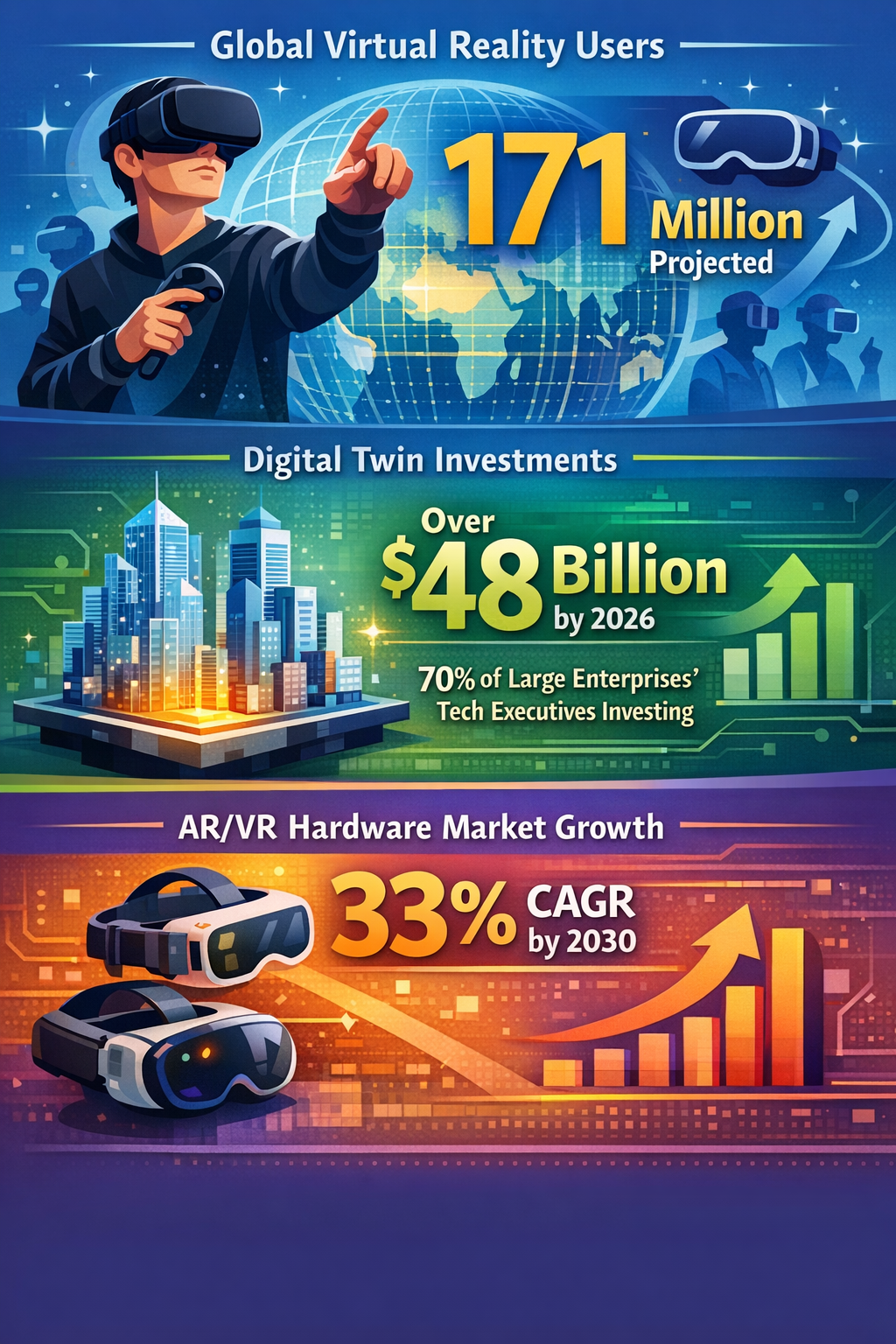
This development constitutes an emerging inflection indicator rather than a mere trend or weak signal. It transcends incremental technology adoption and reflects a growing systemic coupling of cyber-physical assets in sectors such as infrastructure, mining, manufacturing, and entertainment metaverses. The integration of digital twins (projected to attract $48 billion investment by 2026), widespread XR wearable adoption (60+ million units sold annually by 2035), and metaverse industrial applications ($45.7 billion projected by 2026) signals an escalating interdependence (Colleagues Matrix 01/05/2024; Siemens 20/03/2024; Memeburn 07/02/2024).
Time horizon: Medium to long term — 5 to 20 years with high plausibility given current investment trajectories and industrial adoption rates. Sectors exposed include industrial infrastructure, mining, manufacturing, XR hardware/software, entertainment metaverse, and critical national infrastructure.
What Is Changing
The integration of digital twin technology into large-scale infrastructure projects like Rotterdam’s 11 km A16 motorway exemplifies how virtual commissioning is revolutionizing planning and risk management (Verdantix 12/09/2023). These digital twins replicate physical systems, enabling simulations and remote diagnostics that reduce errors and downtime. However, this virtual-physical feedback loop creates a new class of cyber-physical interdependencies with heightened attack surfaces.
Converging with digital twins, XR devices are now rapidly proliferating. Forecasts estimate over 60 million wearable XR units sold annually by 2035, primarily smart glasses designed for immersive industrial applications and entertainment (Siemens 20/03/2024). These devices present a direct interface layer linking humans with augmented operational environments, further entwining cyber and physical dimensions.
Additionally, industrial metaverse investments, expected to surpass $45 billion by 2026, embed digital twin ecosystems with XR-enabled collaboration and automation tools (Memeburn 07/02/2024). Mining companies exemplify this trend, with 70% of large enterprises investing heavily in digital twin and IIoT (Industrial Internet of Things)-powered environments (Colleagues Matrix 01/05/2024).
Yet, underpinning these advancements is an under-recognised cyber risk dimension. The U.S. Cybersecurity and Infrastructure Security Agency (CISA) explicitly warns that connected industrial systems, including IIoT and digital twin environments, represent lucrative, vulnerable attack vectors that could cause physical harm or economic disruption (Persistence Market Research 15/11/2023). This intersection of immersive digital environments with critical physical assets is a fundamentally novel structural condition, distinct from traditional IT risk models.
Disruption Pathway
The systemic risk embedded in cyber-physical integration may evolve into structural change as follows: Initial rapid deployment of digital twins and XR devices accelerates operational efficiencies but inadvertently increases attack surface complexity. Cyber adversaries, nation-state actors, or criminal groups may exploit latent vulnerabilities in connected industrial systems, elevating the frequency and severity of attacks on physical infrastructure.
This would stress existing cybersecurity approaches, which have traditionally isolated operational technology (OT) and information technology (IT) systems rather than converging them. Escalating incidents could lead to widespread operational interruptions, triggering safety hazards and cascades affecting supply chains and energy grids.
In response, regulatory frameworks will need to evolve beyond siloed data security to include cross-sector mandated cyber-physical resilience standards. Industrial incumbents could face rising compliance costs, forcing a restructuring as firms invest in integrated cyber-physical defense architectures or divest vulnerable assets.
Capital allocation may pivot sharply toward firms specializing in secure digital twin integration, XR cybersecurity, and hardened IIoT platforms. This could fuel new industry clusters but also oligopolies controlling critical control infrastructure.
Feedback loops might occur: as attacks incentivize better security, innovation in digital twin architectures emphasizing zero-trust models and decentralized validation could accelerate, further shifting industrial system design paradigms. Conversely, regulatory overreach or fragmented standards may stifle innovation or create jurisdictional conflicts over data sovereignty and operational control.
Why This Matters
For capital allocators, ignoring the cyber-physical interdependence embedded in XR and digital twins could lead to misallocation of resources and unpriced risks. Regulatory bodies must anticipate mandates that specifically address cyber-physical vulnerabilities, extending cybersecurity into physical asset safety and resilience domains.
Competitive positioning will increasingly favor entities with integrated cyber-physical risk management capabilities. Supply chains depending on XR-enabled workflows and digital twin operations may confront new liability paradigms if operational failures stem from cyber breaches.
Government agencies responsible for infrastructure and national security should prioritize scenario planning around systemic cyber-physical disruptions precipitated by vulnerabilities in the immersive/augmented ecosystem. Failing to do so risks a critical blind spot that could invite catastrophic industrial failures or geopolitical conflict.
Implications
This development is likely to catalyze a redefinition of industrial safety and cybersecurity regulations, potentially mandating ‘cyber-physical risk assessments’ as a standard practice. Capital strategies may shift toward ecosystem plays integrating XR hardware, digital twin software, and cybersecurity technology, rather than isolated device or software investments.
It does not herald a dystopian failure of immersive worlds per se, nor an immediate collapse of XR adoption. Instead, it signals a nuanced, system-level adaptation need that current discourse underappreciates. Some may interpret the risks as primarily technical challenges that market forces will solve organically, but the scale and interconnectedness suggest governance intervention and industrial reorganization are more plausible.
Early Indicators to Monitor
- Regulatory drafts or standards emerging explicitly incorporating cyber-physical risk in digital twins and XR-enabled industrial systems.
- Clusters of venture capital investment focused on cybersecurity solutions tailored to digital twin and extended reality industrial deployments.
- Publicly reported cyber incidents impacting digital twin-integrated infrastructure or XR-assisted operations.
- Patent filings addressing secure interoperability and zero-trust designs for XR and digital twin environments.
- Procurement shifts by large industrial firms toward integrated cyber-physical security platforms.
Disconfirming Signals
- Widespread failure of XR or digital twin adoption due to hardware or UX limitations, limiting integration depth.
- Emergence of robust but isolated cybersecurity solutions that fully contain cyber-physical risks without industrial disruption.
- Regulators adopting minimal or delayed standards, with no cross-sector coordination on cyber-physical resilience.
- Industry consensus aligning on decentralized, open-system standards that distribute rather than concentrate cyber-physical integration risks.
Strategic Questions
- How should organizations measure and price cyber-physical risk exposure within XR/digital twin-enabled operations?
- What inter-agency regulatory frameworks or industry coalitions are needed to govern the cyber-physical interfaces in immersive industrial environments?
Keywords
Digital Twin; Extended Reality (XR); Cybersecurity; Industrial Metaverse; Cyber-Physical Risk; Industrial Internet of Things (IIoT); Critical Infrastructure; Governance; Regulation
Bibliography
- A major 11 km section of the A16 motorway in Rotterdam achieved virtual commissioning prior to construction through a digital twin built on BIM and 3D design data, highlighting the potential for improved planning, validation and risk reduction. Verdantix. Published 12/09/2023.
- The U.S. Cybersecurity and Infrastructure Security Agency has identified connected industrial systems, including IIoT-based digital twin environments, as potential targets for cyber threats. Persistence Market Research. Published 15/11/2023.
- By 2026, global digital twin investments are projected to exceed $48 billion, with 70% of C-suite technology executives at large enterprises actively investing in mining technologies. Colleagues Matrix. Published 01/05/2024.
- Smart glasses technology is accelerating at a rapid pace with an expected 60+ million extended reality (XR) wearable devices sold annually by 2035. Siemens. Published 20/03/2024.
- In 2026, the entertainment metaverse is projected to reach $35.27 billion, while the industrial metaverse may touch $45.7 billion. Memeburn. Published 07/02/2024.