
The Latent Urban Resilience Paradox: How Rapid Infrastructure Digitalization Could Expose Megacities to Cascading Systemic Risks
Urbanization and megacity growth are accelerating globally, with intense investments into smart infrastructure promising economic benefits. Yet, beneath this surge lies a latent paradox: rapid digital integration may create new, systemic vulnerabilities not widely recognised. This insight paper identifies an under-explored weak signal where accelerated urban digitalization—particularly in Asia-Pacific and the Middle East—could fundamentally shift risk profiles, regulatory priorities, and capital allocation in the next 5–20 years.
While the narrative of smart cities focuses on efficiency and resilience, escalating infrastructural digital dependency may unintentionally generate new systemic cascade risks—an inflection that could disrupt urban governance, shift industrial structures, and reframe infrastructure investment priorities globally. This analysis synthesizes developments across regions and sectors, moving beyond conventional smart city optimism to highlight a structural challenge embedded in rapid urban digitalization.
Signal Identification
This development qualifies as an emerging inflection indicator due to its early-stage but accelerating manifestation with disproportionate potential impact on urban systems. The signal involves the coupling of rapid smart infrastructure deployment with heightened exposure to interconnected cyber-physical cascade failures, which remains under-recognised compared to traditional urban risk frameworks.
The estimated time horizon for this inflection is 5–20 years, matching the expected urban infrastructure modernization waves (Kaiso Research 20/07/2026).
Plausibility is assessed as high given ongoing global capital commitments and digital dependency trends.
Sectors exposed include urban infrastructure, public transport, water management systems, security operations, and emergency preparedness across Asia-Pacific, Middle East, North America, and Europe.
What Is Changing
Across multiple regions, rapid urbanization is driving intense investment into smart city infrastructure—particularly digital mobility solutions, smart water management, and autonomous security operations (6WResearch 19/07/2026; Persistence Market Research 12/06/2026; Mordor Intelligence 28/05/2026).
Governments are backing large-scale programs to digitize critical infrastructure, from transport networks in Asia-Pacific with a CAGR of 6.8% (6WResearch 19/07/2026) to sovereign AI for urban security across Middle East countries such as Saudi Arabia (Mordor Intelligence 28/05/2026). These investments create integration of cyber-physical systems at an unprecedented scale.
However, urban expansion concurrently amplifies exposure to natural hazards, such as cyclones and hurricanes in North America and Asia (Persistence Market Research 17/06/2026), which increasingly interact with digital infrastructure dependencies in novel ways.
This convergence of rapid digital deployment with climate risk exposure points to a substantive, under-recognised structural theme: a latent resilience paradox where smart infrastructure’s benefits coexist with increasing systemic fragility should digital-physical interdependencies trigger cascading failures.
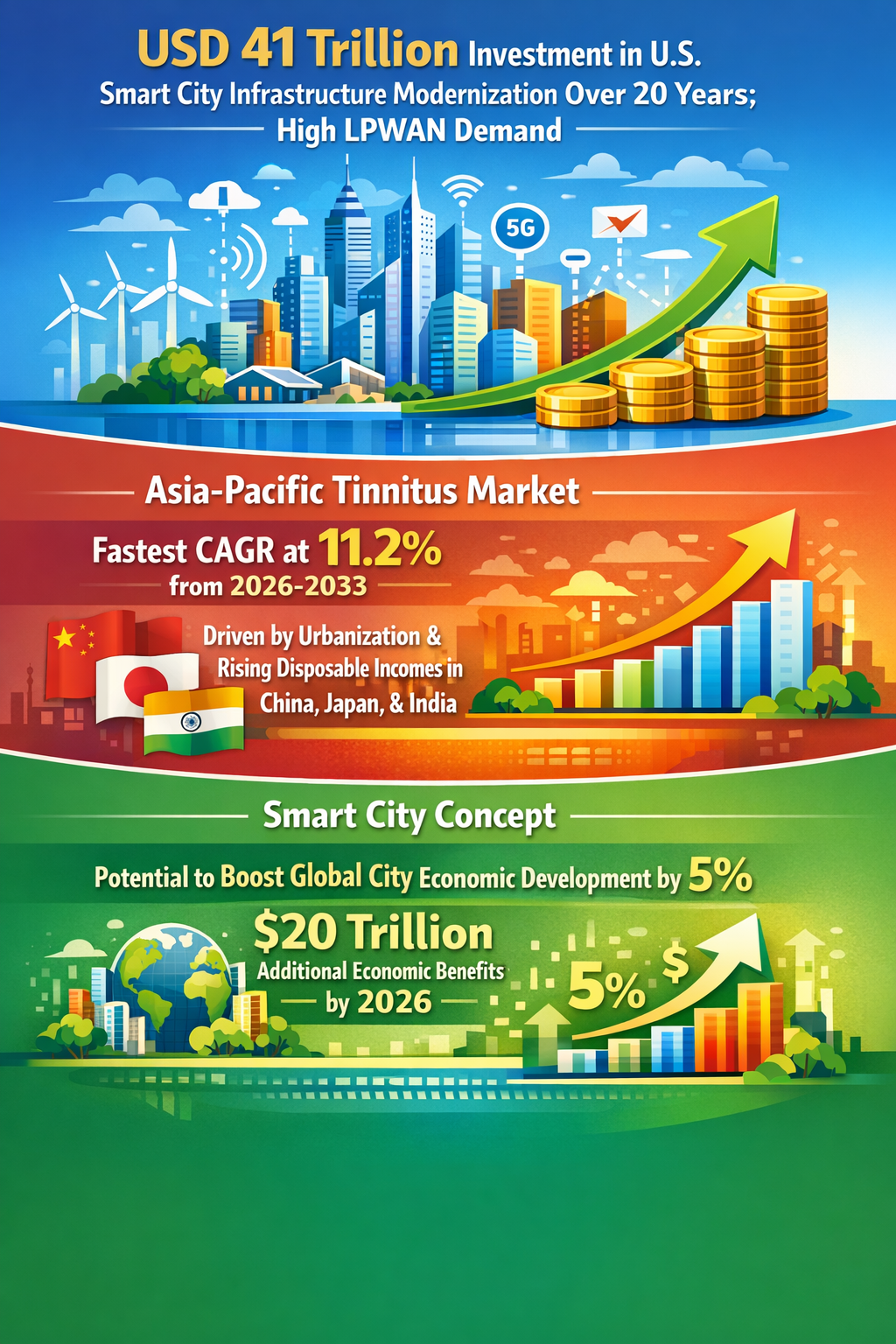
Furthermore, the fragmented regulatory ecosystems, exemplified by Europe’s multi-layered smart city governance (Mean CEO Blog 01/08/2026), complicate coordinated risk management and adaptation, potentially magnifying vulnerabilities. The scale of planned infrastructure modernization in the U.S.—estimated at USD 4.1 trillion over 20 years (Kaiso Research 20/07/2026)—underscores the magnitude of systemic integration underway globally.
Disruption Pathway
The escalation of this signal begins with accelerated smart infrastructure roll-outs embedding complex software-controlled operations across urban systems. The convergence of sensors, low-power wide area networks (LPWAN), AI-driven management, and autonomous security functions creates an interdependent cyber-physical urban fabric vulnerable to failure propagation.
If a localized malfunction—from cyberattacks, extreme weather causing physical damage, or software glitches—disrupts one subsystem (e.g., water supply sensors or transit control), the impact could cascade through connected infrastructure layers. For example, water management failures could impair healthcare facility operations during emergencies or affect mobility aids for vulnerable populations (Persistence Market Research 10/06/2026).
Current infrastructure governance, designed largely around siloed risk and regulatory domains, lacks the integrated frameworks needed to anticipate and manage cascading risk. Regulatory fragmentation (Mean CEO Blog 01/08/2026) and capital allocation primarily funneling toward efficiency rather than resilience compound this fragility.
As urban digital infrastructure becomes critical economic backbone, failures may prompt systemic economic shocks, shifting capital allocation away from expansive digitalization toward decentralized, resilient alternatives. This could trigger a feedback loop as investors and governments recalibrate trust in digital systems.
Eventually, this dynamic may force a structural repositioning: robust integrated cyber-physical risk governance architectures, revised regulatory frameworks harmonizing across sectors and borders, and the rise of resilient infrastructure industrial clusters emphasizing fail-safes over pure scalability.
Why This Matters
For senior decision-makers, this insight highlights a pressing need to reconsider the risk–return tradeoff of smart urban infrastructure investments beyond initial productivity gains. Capital deployed under optimism about growth and efficiency may be exposed to latent systemic risk that could materialize in amplified liability, infrastructure downtime, and social disruption.
Regulators will face increasing pressure to harmonize digital and physical risk standards, oversee integrated resilience testing, and develop frameworks for liability in cascading urban failure scenarios. This may alter industrial competitive positioning; technology vendors that integrate resilience features may outcompete those focused solely on efficiency.
Supply chains could be disrupted as component dependencies (LPWAN devices, AI algorithms, mobility equipment) become choke points for cascade initiation or propagation. Governance models that fail to adapt risk management to systemic interdependencies may see diminished legitimacy and effectiveness.
Implications
This development could plausibly drive a systemic resetting of urban digital infrastructure paradigms, where resilience integration becomes a decisive factor in capital allocation, industrial strategy, and regulatory design. Urban planners and investors may increasingly prioritize modular, decentralized solutions to limit cascade pathways.
Nonetheless, this is not a deterministic crisis narrative but a contingent pathway influenced by governance choices, technological innovation, and international cooperation on standards. It might be transient noise if smart city deployments embed resilience proactively or if emergent AI and monitoring tools successfully predict and mitigate cascades.
Competing interpretations might view these risks as manageable controls within existing frameworks or emphasize the overwhelmingly positive economic outcomes from smart urban investments (Trade Arabia 24/01/2026). However, ignoring cascade vulnerability could leave urban systems unprepared.
Early Indicators to Monitor
- Escalation in reported cyber-physical failure events or near-misses in smart urban infrastructure (public incident reports, insurance claims).
- Regulatory drafts or standards formation around integrated urban system resilience and cyber-physical risk management.
- Venture funding clustering or capital reallocation patterns favoring resilient, decentralized urban infrastructure technologies.
- Patent filings related to cascade detection, AI-based urban risk mitigation, or decentralized infrastructure controls.
- Procurement shifts from purely efficiency-driven solutions to those explicitly emphasizing resilience and systems redundancy.
Disconfirming Signals
- Rapid emergence of effective unified regulatory frameworks harmonizing urban cyber-physical risk across multiple jurisdictions.
- Demonstrated success of large-scale smart city infrastructure deployments without recorded systemic cascade incidents over extended periods.
- Major technological breakthroughs in real-time, AI-driven universal cascade prevention and recovery for urban systems.
- Significant capital withdrawal from digital infrastructure investments due to unrelated macroeconomic shocks reducing investment pressure.
Strategic Questions
- How should capital deployment strategies be adjusted to balance rapid digitalization against emerging systemic urban infrastructure risks?
- What regulatory frameworks and governance models are needed to detect, prevent, and manage cascading failures in integrated urban cyber-physical systems?
Keywords
Urbanization; Megacities; Smart Cities; Cyber-Physical Systems; Systemic Risk; Urban Resilience; Digital Infrastructure; Regulatory Fragmentation; Capital Allocation; Cascading Failures
Bibliography
- Asia is forecasted to be the fastest-growing region with a CAGR of 6.8% from 2026 to 2032, backed by rapid urbanization and government initiatives aimed at improving public transport systems. 6WResearch. Published 19/07/2026.
- Fastest Growing Region: Asia Pacific is the fastest growing region, projected at a 13.7% CAGR fueled by rapid urbanization, water scarcity, and large-scale government-backed smart city programs. Persistence Market Research. Published 12/06/2026.
- The Middle East and Africa are opening new opportunities through sovereign AI programs, smart city investments, and critical infrastructure protection work in countries such as Saudi Arabia and the United Arab Emirates. Mordor Intelligence. Published 28/05/2026.
- Rapid urbanization across the U.S., China, India, and Southeast Asia is expanding the structural base exposed to cyclone and hurricane risk. Persistence Market Research. Published 17/06/2026.
- Smart city infrastructure investment: U.S. city governments plan USD 41 trillion in infrastructure modernization over 20 years, creating massive sustained LPWAN procurement demand. Kaiso Research. Published 20/07/2026.
- Europe tends to offer more fragmented regulation, denser public-policy influence, and stronger smart-city integration opportunities. Mean CEO Blog. Published 01/08/2026.
- The smart city concept has the potential to boost the economic development of global cities by 5% and deliver $20 trillion in additional economic benefits by 2026, said a report released ahead the Future Cities Show in Dubai. Trade Arabia. Published 24/01/2026.
- Rapid urbanization and improving healthcare infrastructure in regions such as the Asia Pacific and Latin America present significant opportunities for expanding the reach of affordable manual wheelchairs, walking aids, and mobility scooters. Persistence Market Research. Published 10/06/2026.