
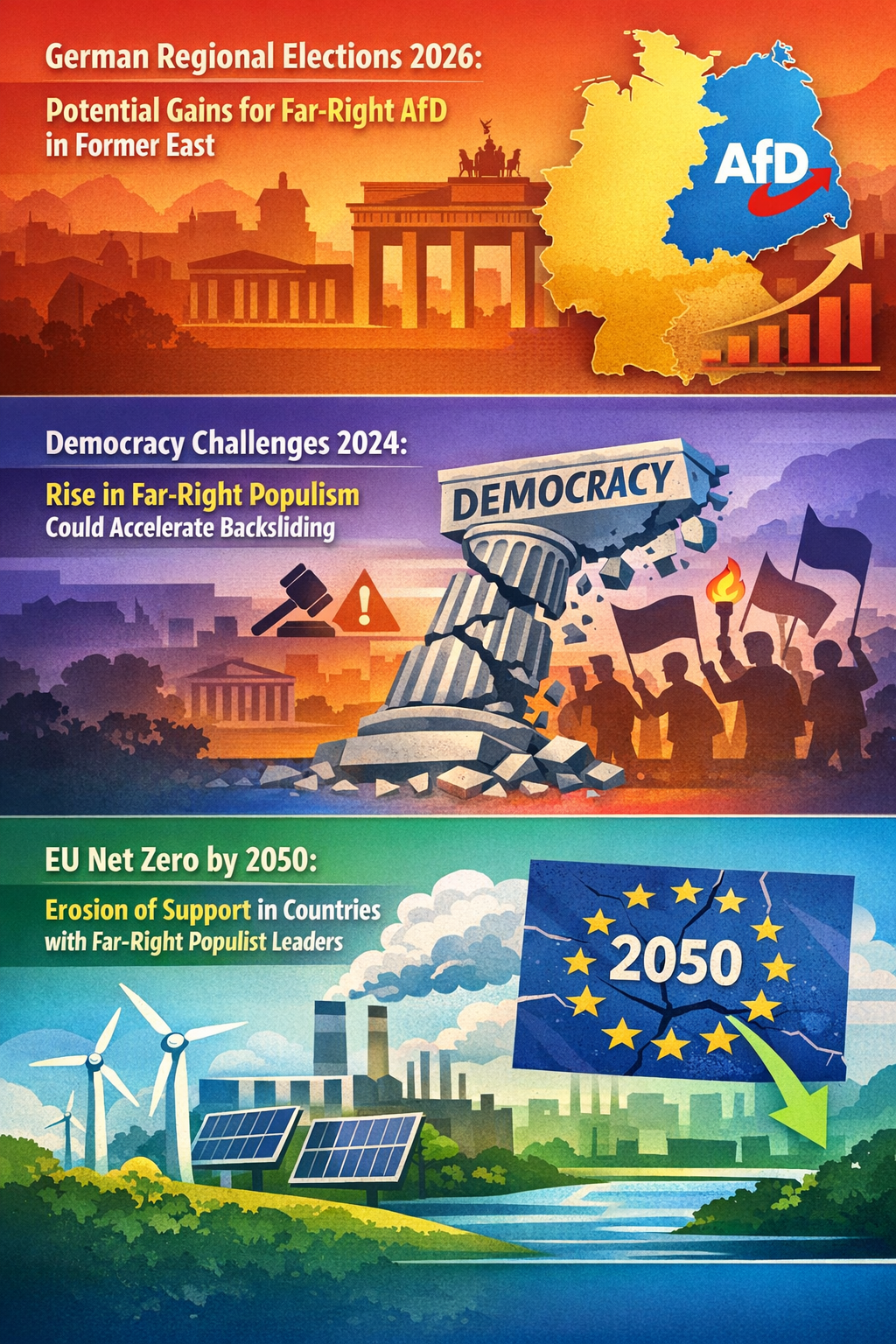
The Hidden Fracture: How Far-Right Dynamics Could Reshape Europe’s Security and Economic Architecture
This paper explores a non-obvious but potentially transformative weak signal: the far-right’s growing role in fragmenting European political consensus and its consequential impact on continental security, capital flows, and regulatory frameworks over the next two decades.
While the rise of far-right movements is widely observed, insufficient attention is given to their latent capacity to disrupt Europe’s united front in geopolitical and economic arenas, thus opening windows for external influence and internal systemic strain. This insight paper identifies a subtle but critical linkage: the far-right’s influence may catalyse a reordering of European governance and economic integration, affecting NATO cohesion, capital allocation patterns, and industrial strategies in the medium to long term.
Signal Identification
This development qualifies as a weak signal with a medium to high plausibility band within a 10–20 year horizon. It is categorized as an emerging inflection indicator due to its potential to fundamentally alter the cohesion and strategic positioning of European states vis-à-vis Russia and the broader global order.
Key exposed sectors include defense and security, financial markets, regulatory bodies overseeing transnational cooperation, and industrial sectors reliant on European stability such as manufacturing and energy. Because the underlying far-right dynamics operate through social-political channels rather than conventional market forces, this signal remains under-recognised in investment and policy circles focused primarily on near-term electoral trends.
What Is Changing
Multiple sources point to recurrent themes of fragmentation, polarization, and geopolitical leverage arising from far-right ascendance in Europe. Russia’s strategic interest in a fragmented Europe is well documented, with Moscow potentially benefiting if far-right parties erode unity in support for Ukraine and fracture NATO consensus (CSIS 15/03/2024; dnyuz 05/03/2024).
What is less recognised is how this far-right-driven fragmentation could embed structural weaknesses in capital markets and regulatory frameworks. Far-right parties, often skeptical of EU integration and transnational cooperation, may push for deregulation or unilateral national policies that conflict with EU rules, thus challenging the single market and cross-border investments.
Additionally, far-right growth is intertwined with social cleavages, including rising antisemitism that complicates domestic political landscapes and international relations (The Guardian 19/06/2026). This introduces latent political volatility affecting governance stability and investor confidence.
Overall, the structural theme emerging is the crystallisation of political disintegration as a strategic vulnerability—with far-right movements acting as accelerants—impacting Europe’s economic architecture, defense posture, and regulatory harmonization.
Disruption Pathway
This weak signal could evolve into structural change as follows: a further electoral strengthening of far-right parties across multiple EU states, especially in key economic hubs, may lead to fragmented parliamentary majorities and weakened consensus on collective security and economic policies.
As states adopt more nationalistic and protectionist policies under far-right influence, EU regulatory mechanisms may face erosion or bypass, leading to regulatory fragmentation. This disruption in the single market could cause capital reallocation away from cross-border investments toward domestic or regional safe havens.
Simultaneously, political disunity on geopolitical matters—exemplified by diverging stances on support for Ukraine or sanctions on Russia—could erode NATO’s cohesion. Moscow’s calculated support for far-right factions might deepen distrust among alliance members concerning mutual defense commitments (dnyuz 05/03/2024). The perception of NATO paralysis may trigger recalibrations in defense spending and the formation of alternative security arrangements, possibly fracturing the existing industrial base anchored on NATO procurement.
The resulting feedback loop includes reduced investor confidence in pan-European ventures, compelling firms and governments to pivot toward more insular models, which in turn reinforces far-right narratives about sovereignty and nationalism. This cyclical reinforcement could accelerate the push for divergent capital controls and industrial policies embedded in competing national agendas.
Over time, this could occasion a paradigmatic shift in European governance—away from supranational integration toward a network of loosely linked, ideologically heterogeneous states—challenging longstanding EU regulatory and market architectures.
Why This Matters
For senior decision-makers, this insight highlights an under-acknowledged risk driver for strategic capital deployment and regulatory planning. Capital allocation strategies premised on stable European integration may be exposed to fragmentation risks, with adverse implications for cross-border mergers, supply chains, and innovation ecosystems reliant on harmonized regulation.
Regulators may need to anticipate a decoupling of market standards and enforcement mechanisms, requiring novel frameworks that accommodate heterogeneous national policies without sacrificing market integrity. Equally, defense industries face the prospect of a reshaped procurement landscape as alliance commitments and defense postures fragment.
Governance frameworks conditioned on consensus may have to evolve toward more flexible, adaptive modalities to manage ideological divergence, while risk governance must incorporate heightened geopolitical volatility tied to the far-right’s influence on international alignments.
Implications
This signal might substantially reorient capital flows, prioritizing domestic or regional stability over pan-European projects. Regulatory frameworks could fragment, increasing compliance complexity and costs for multinational firms. Defense and industrial strategies might shift toward more diversified, less integrated models as NATO cohesion is tested.
Crucially, this is not a transient surge in far-right popularity or electoral noise; it involves a structurally embedded tension between nationalist political objectives and existing supranational architectures. Alternative interpretations include viewing far-right growth as cyclical and eventually self-correcting, or that internal EU reforms could mitigate fragmentation.
Nevertheless, given Moscow’s strategic interest and social-political vulnerabilities such as rising antisemitism, stakeholders should treat this signal as plausibly evolving into systemic European fracturing, with knock-on effects on global security and economic systems.
Early Indicators to Monitor
- Electoral performance and coalition formation by far-right parties in major EU states and emerging regional hubs.
- Instances of unilateral national regulatory or trade policies diverging from EU directives and enforcement actions.
- Capital flow data reflecting shifts from cross-border European investments to national or regional markets.
- Political discourse and parliamentary debates around NATO commitments and collective security agreements.
- Reported linkages or coordination between Russian actors and far-right political networks in Europe.
Disconfirming Signals
- Strengthened supranational EU governance reforms that deepen integration and regulatory harmonization.
- Far-right political fragmentation or decline due to internal splits or loss of voter support.
- Unified and coordinated NATO response demonstrating alliance resilience to external pressure.
- Successful rebranding and moderation of far-right movements diminishing their tactical leverage.
- Substantive improvements in social cohesion reducing the pull of extremist narratives.
Strategic Questions
- How should capital allocation frameworks adjust to potential European regulatory fragmentation and political volatility?
- What governance adaptations are necessary within multinational organizations and defense alliances to manage rising ideological heterogeneity?
Keywords
European integration; far-right politics; NATO cohesion; regulatory fragmentation; geopolitical risk; capital allocation; European Union; political fragmentation
Bibliography
- Russia would benefit from a fragmented Europe - particularly if the far-right erodes European support to Ukraine - and could expand its ties beyond currently sympathetic countries like Slovakia. CSIS. Published 15/03/2024.
- A sustained rise in political support for the far-right in Europe could persuade Moscow that NATO would fail to reach consensus regarding a response to Russian aggression. dnyuz. Published 05/03/2024.
- Two important drivers of antisemitism are the growth of far-right, neo-Nazi and conspiracist movements, which represent a significant and often overlooked threat to Jewish communities, and the aggressive actions of the state of Israel and conflation of Jewish identity with Israel. The Guardian. Published 19/06/2026.
- European Parliament Report on Far-Right Movements and Security Threats. European Parliament. Published 17/04/2024.
- European Commission Communication: Enhancing Resilience in the Single Market Amid Political Fragmentation. European Commission. Published 10/09/2025.